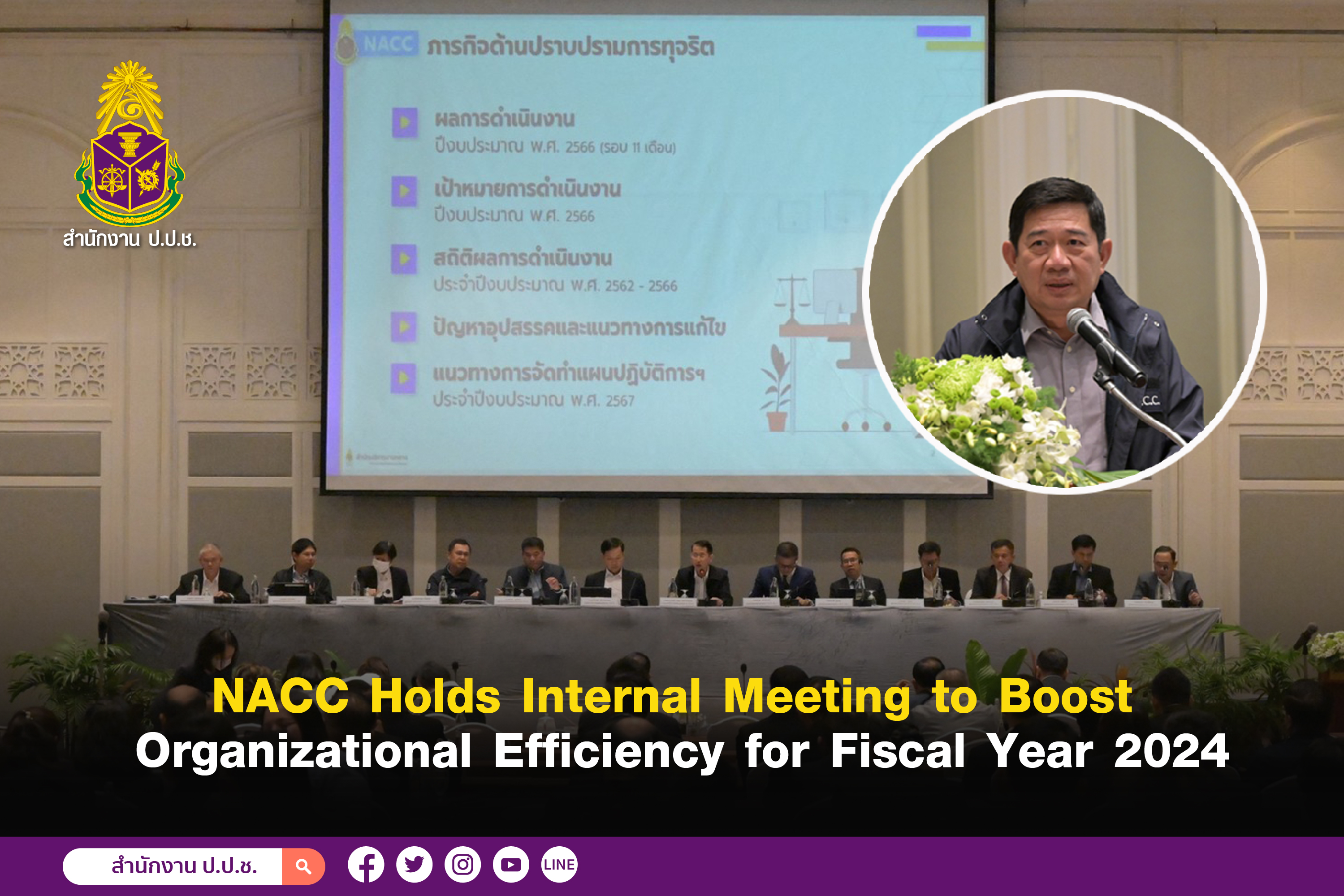
NACC Holds Internal Meeting to Boost Organizational CPI Efficiency for Fiscal Year 2024
จากไชต์: Office of The National Anti - Corruption Commission (ONACC)
จำนวนผู้เข้าชม: 617
The National Anti-Corruption Commission (NACC), led by its executive team, organized activities aimed at enhancing the efficiency of its administrative functions and elevating the Corruption Perceptions Index (CPI) for the 2024 fiscal year.
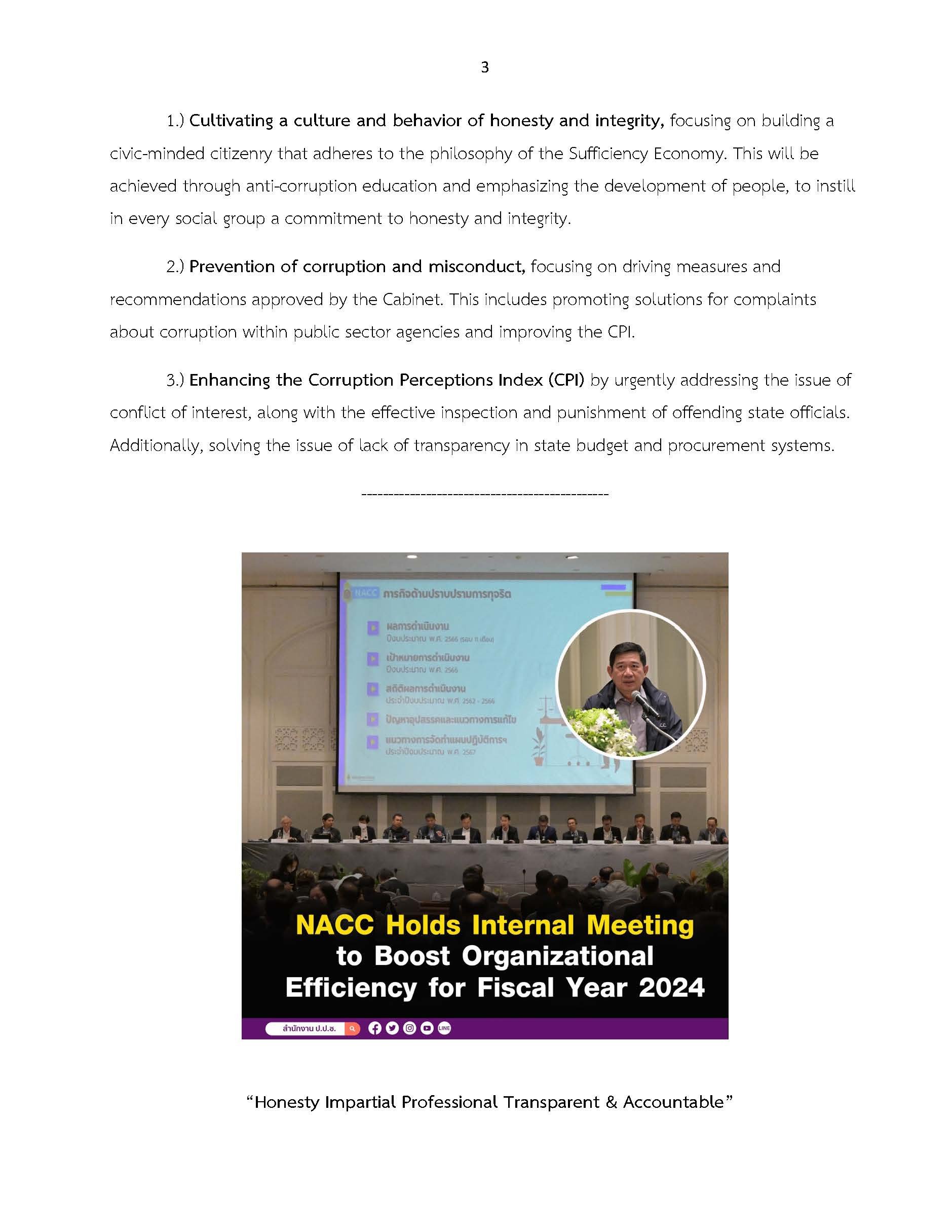
Pol Gen Watcharapol Prasarnrajkit, President of NACC, along with other top executives from both the central and regional offices, participated in the seminar from September 7th-9th, 2023 to align their strategies for preventing and suppressing corruption within the organization.
The seminar outlined guidelines for future anti-corruption initiatives, ensuring that all operational plans within the NACC are coherent and aimed in the same direction. Upon execution, these plans will be rigorously monitored and evaluated using specific performance indicators to measure the effectiveness of their implementation. These indicators are designed to align with the overarching objectives and goals of the organization's strategic plans, enabling a clear assessment of success.
One of the crucial aspects of defining these performance indicators is instilling a fundamental sense of awareness and responsibility among all staff and officers within the organization. This is meant to foster a shared sense of ownership and accountability towards achieving the organizational goals, thereby driving success in a unified direction. Concurrently, this initiative is also expected to enhance the effectiveness of the annual budgeting and operational plans for the 2024 fiscal year, contributing to the attainment of the national anti-corruption strategy and integrated plans against corruption and misconduct.
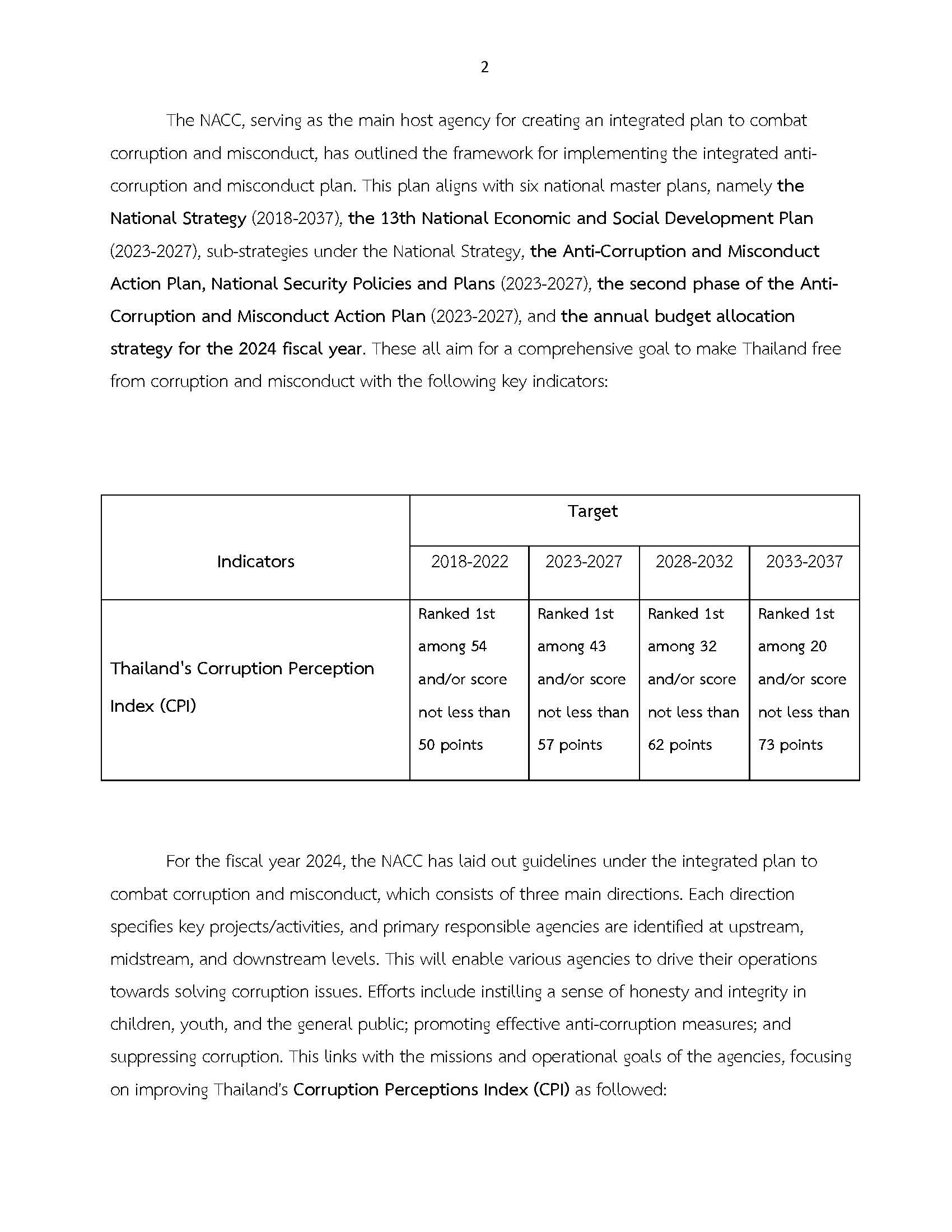
The NACC, serving as the main host agency for creating an integrated plan to combat corruption and misconduct, has outlined the framework for implementing the integrated anti-corruption and misconduct plan. This plan aligns with six national master plans, namely the National Strategy (2018-2037), the 13th National Economic and Social Development Plan (2023-2027), sub-strategies under the National Strategy, the Anti-Corruption and Misconduct Action Plan, National Security Policies and Plans (2023-2027), the second phase of the Anti-Corruption and Misconduct Action Plan (2023-2027), and the annual budget allocation strategy for the 2024 fiscal year. These all aim for a comprehensive goal to make Thailand free from corruption and misconduct with the following key indicators:
|
|
|
Target |
|
|
|
Indicators |
2018-2022 |
2023-2027 |
2028-2032 |
2033-2037 |
|
Thailand's Corruption Perception Index (CPI) |
Ranked 1st among 54 and/or score not less than 50 points |
Ranked 1st among 43 and/or score not less than 57 points |
Ranked 1st among 32 and/or score not less than 62 points |
Ranked 1st among 20 and/or score not less than 73 points |
For the fiscal year 2024, the NACC has laid out guidelines under the integrated plan to combat corruption and misconduct, which consists of three main directions. Each direction specifies key projects/activities, and primary responsible agencies are identified at upstream, midstream, and downstream levels. This will enable various agencies to drive their operations towards solving corruption issues. Efforts include instilling a sense of honesty and integrity in children, youth, and the general public; promoting effective anti-corruption measures; and suppressing corruption. This links with the missions and operational goals of the agencies, focusing on improving Thailand's Corruption Perceptions Index (CPI) as followed:
1.) Cultivating a culture and behavior of honesty and integrity, focusing on building a civic-minded citizenry that adheres to the philosophy of the Sufficiency Economy. This will be achieved through anti-corruption education and emphasizing the development of people, to instill in every social group a commitment to honesty and integrity.
2.) Prevention of corruption and misconduct, focusing on driving measures and recommendations approved by the Cabinet. This includes promoting solutions for complaints about corruption within public sector agencies and improving the CPI.
3.) Enhancing the Corruption Perceptions Index (CPI) by urgently addressing the issue of conflict of interest, along with the effective inspection and punishment of offending state officials. Additionally, solving the issue of lack of transparency in state budget and procurement systems.

Related


